GIGI PORTAL
Loading page…
DeepSeek-AI · research@deepseek.com
DeepSeek-AI Technical Report, September 2026.
DeepSeek-V4.1-Flash is a 552-billion parameter multimodal AI model that cuts the memory required to remember long conversations by up to 87.5% while running significantly faster. It achieves this through a dual-brain architecture that reads inputs with just 8 billion parameters and uses aggressive 4-bit memory compression to easily handle up to one million tokens.
Modern AI agents take hundreds of actions and read massive codebases, but storing that conversation memory (the KV cache) quickly overwhelms expensive GPU and SSD hardware. DeepSeek solves this fundamental bottleneck by reducing active memory consumption by 4× in GPU RAM and 8× on persistent SSD storage without degrading output quality. As a result, developers and enterprises can run frontier-level long-horizon agents at a fraction of today’s operational costs. This proves that high-performance intelligence can scale through smarter mathematical design rather than just brute-force compute.
The core paper simplified
When you ask an AI model to analyze a whole codebase or keep a long multi-step conversation going, the model doesn’t just read the words once. It converts every single word into mathematical vectors (called Key-Value or KV caches) and keeps them in ultra-fast GPU memory (HBM). At 100,000 or 1,000,000 tokens, this memory explodes: a single conversation can swallow dozens of gigabytes of expensive VRAM. This makes serving long-context agents shockingly costly.
DeepSeek introduced a smart split between reading and writing. When reading your prompt or code repository (the prefill phase), the model activates only 8 billion parameters, cutting input processing compute in half. When generating the answer (the decode phase), it activates 16 billion parameters. By building the answer memory directly from the reader’s final state, the model bypasses redundant calculations and runs much faster on long inputs.
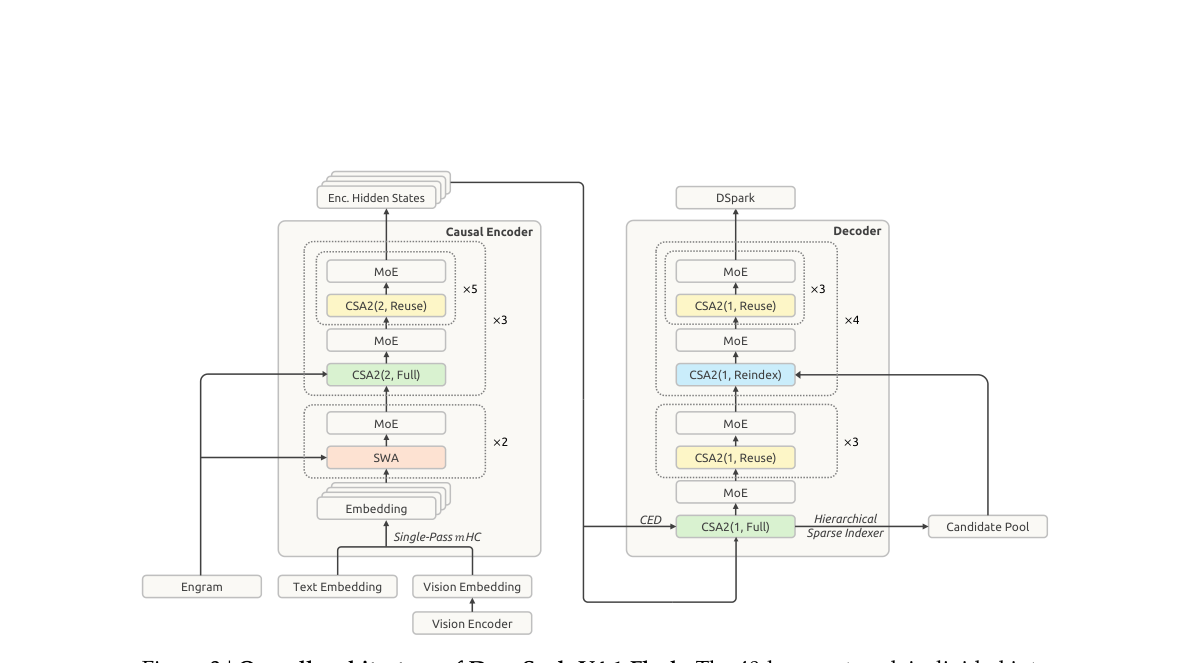
This diagram maps out the complete 40-layer brain of DeepSeek-V4.1-Flash. The left half shows the 20-layer Causal Encoder that digests user prompts and images using only 8 billion active parameters. The right half shows the 20-layer Decoder that takes the encoder’s compressed memory and generates the answer with 16 billion active parameters. The colored blocks illustrate where the layers share their memory (CSA2 Full, Reindex, and Reuse modes) so nothing is recalculated twice.
Splitting the model into a lightweight 8B reader (prefill) and a 16B writer (decode) halves input processing costs while keeping memory seamlessly shared across layers.
Instead of forcing every single layer of the neural network to store its own duplicate copy of conversation memory, Compressed Sparse Attention 2 (CSA2) lets layers share memory in three modes: Full, Reindex, and Reuse. On top of that, DeepSeek compressed this memory down to ultra-compact 4-bit floating point numbers (FP4). Together, these innovations slash runtime GPU memory by 75%.
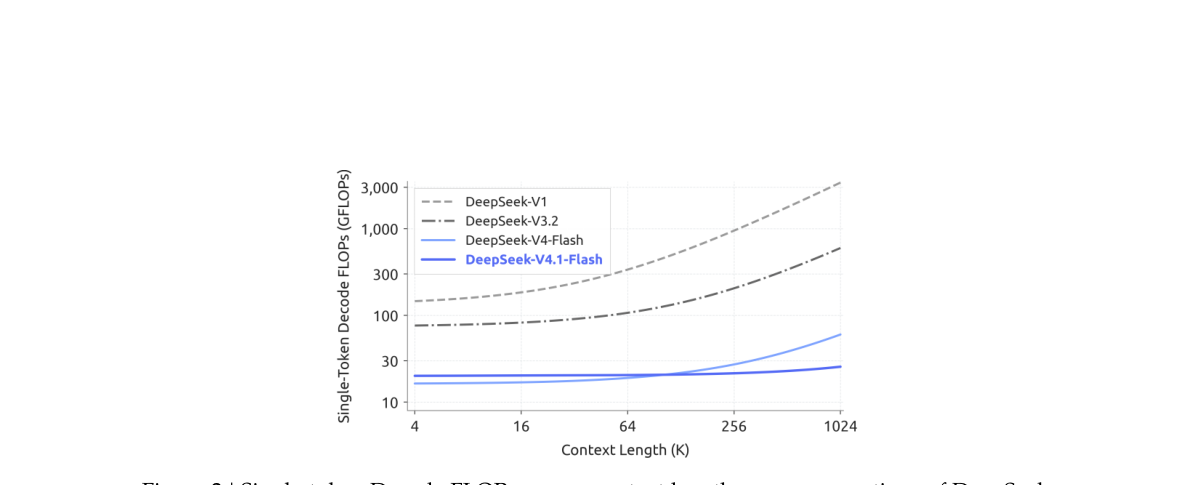
This chart compares how much computational work (Decode FLOPs) models require for every generated word as conversations grow from 4,000 tokens all the way to 1,000,000 tokens. Conventional models slope steeply upward, meaning longer chats get dramatically slower and costlier. DeepSeek-V4.1-Flash’s line remains nearly completely flat across all context lengths.
Extending the context length 256-fold (from 4K to 1M tokens) increases decode compute by only 25%. Massive codebases and long documents no longer suffer the steep computational penalty of past models.
In agentic workflows, long sessions must be saved to SSDs so the user or agent can continue later. Normally, saving all local attention states takes hundreds of megabytes per session. DeepSeek uses a technique called SWA Bounded Replay: instead of saving everything to disk, it discards local window states and simply replays the last few tokens on the fly when needed. This cuts SSD disk storage by roughly 88% (1/8 of predecessor size) with zero noticeable loss in accuracy.
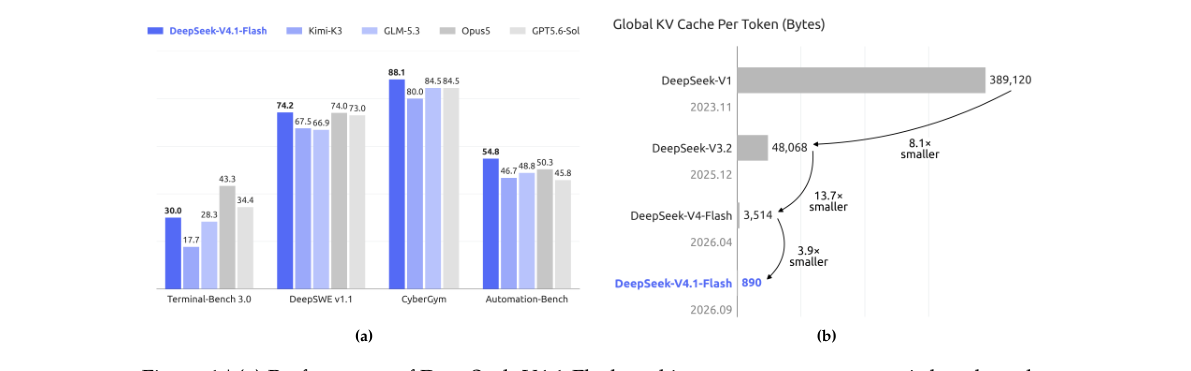
This graphic presents two key achievements: On the left (a), bar charts show DeepSeek-V4.1-Flash topping frontier leaderboards on real-world coding benchmarks like Terminal-Bench 2.1 (90.6) and DeepSWE (74.2). On the right (b), the timeline displays the dramatic reduction in per-token memory footprint—falling from 389,000 bytes in DeepSeek-V1 down to just 890 bytes here.
DeepSeek-V4.1-Flash matches or beats top frontier systems while requiring 4× less GPU memory than its direct predecessor and 437× less memory than early models.
Trained on 45 trillion multimodal tokens, DeepSeek-V4.1-Flash matches or surpasses models three times its size on everyday coding, software engineering, and tool use. It ranks #1 on Terminal-Bench 2.1 (90.6) and scores 74.2 on DeepSWE v1.1, completing over 95% of real-world agent tasks while keeping single-token decode compute virtually flat as context expands.
Key performance metrics, memory benchmarks, and milestone numbers
DeepSeek-AI (2026). DeepSeek-V4.1-Flash: Pushing the Limits of KV Cache Compression. DeepSeek-AI Technical Report. Transcribed on Gigi Papers.Transcribed from the original PDF; tables are summarized in prose — see the original for full tabular data. © DeepSeek-AI · Report and checkpoints at https://huggingface.co/deepseek-ai/DeepSeek-V4.1-Flash.