GIGI PORTAL
Loading page…
Sakana AI
arXiv:2606.21228 [cs.LG] (Sakana Fugu Technical Report).
Sakana Fugu is a family of learned orchestrator models that dynamically coordinate a team of specialized frontier AI agents behind a single, unified interface. By selecting the optimal worker or combining multiple agents per task, Fugu outperforms every individual frontier model without needing a massive training run.
No single AI model is the best at everything: one excels at mathematics, another at software engineering, and a third at creative analysis. Fugu proves that true frontier capability can be achieved by smartly orchestrating existing models rather than spending tens of millions of dollars training ever-larger monoliths. This democratizes AI performance, allowing developers to surpass top proprietary systems through collective intelligence. Furthermore, it gives organizations modular control to swap models, meet privacy rules, and optimize speed versus quality on demand.
The core paper simplified
Training bigger monolithic models is hitting diminishing returns and astronomical costs. Sakana AI realized that different frontier models already possess unique superpowers: Gemini might dominate mathematics, Claude leads software engineering, and GPT excels at multi-step planning. Fugu treats intelligence as an ensemble sport: instead of one player doing everything, an AI conductor directs the ensemble.
To the user, Fugu looks and acts like a single standard language model. Behind the scenes, a lightweight prediction head reads the query and immediately decides which specialized agent in its worker pool should handle the job. Because it routes based on hidden representations before generating words, orchestration adds almost zero latency.
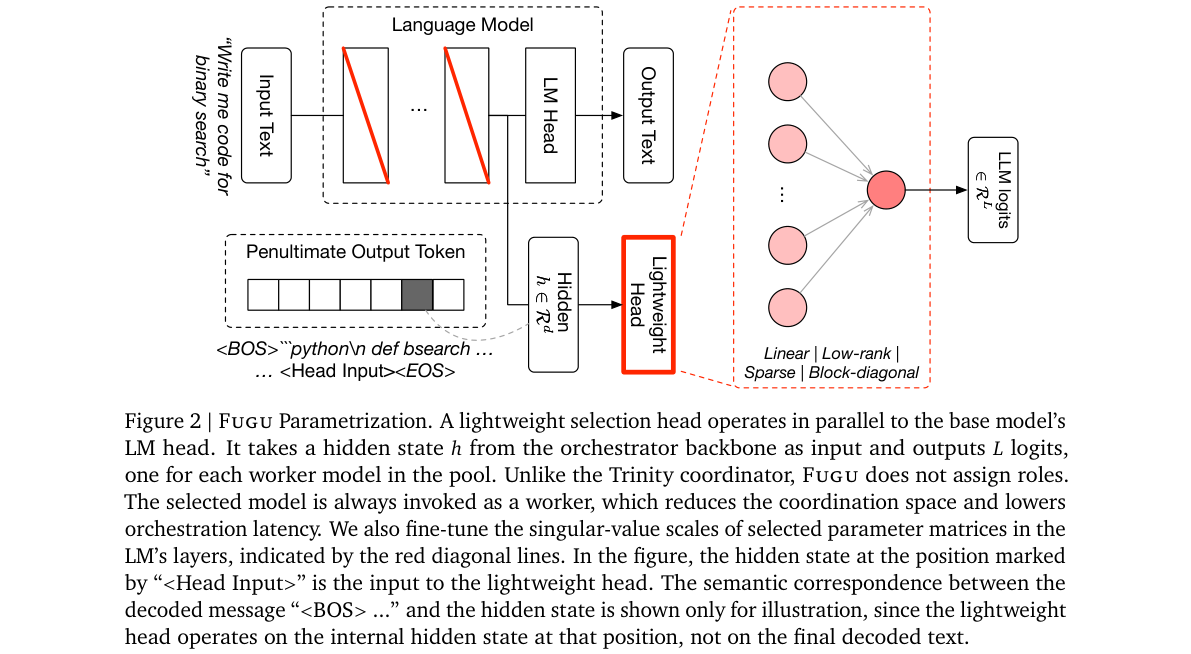
This diagram reveals how Fugu makes decisions at near-zero latency. When a user submits a query, the orchestrator model calculates an internal hidden representation at an early position. Instead of slowly generating text tokens, a lightweight selection head scores which frontier worker model in the pool (e.g. Gemini, Claude, GPT) is best suited for the task and immediately dispatches the request to that worker.
Routing happens via an internal neural classifier before words are generated, eliminating orchestration delay and delivering responses as fast as a direct model call.
Sakana created two tailored operating modes: Fugu (Interactive Speed) routes each query to the single best worker in the pool, running at the speed of a single model call while delivering optimal results. Fugu-Ultra (Maximum Quality) assembles multi-agent collaborative workflows, orchestrating multiple models to draft, critique, verify, and refine answers for the toughest problems.
Fugu wasn’t programmed with hand-written rules. It was trained using large-scale supervised fine-tuning on verifiable problems, evolutionary algorithms to discover optimal agent collaboration patterns, and group-relative reinforcement learning. It learned through trial and error exactly which model shines on which type of question.
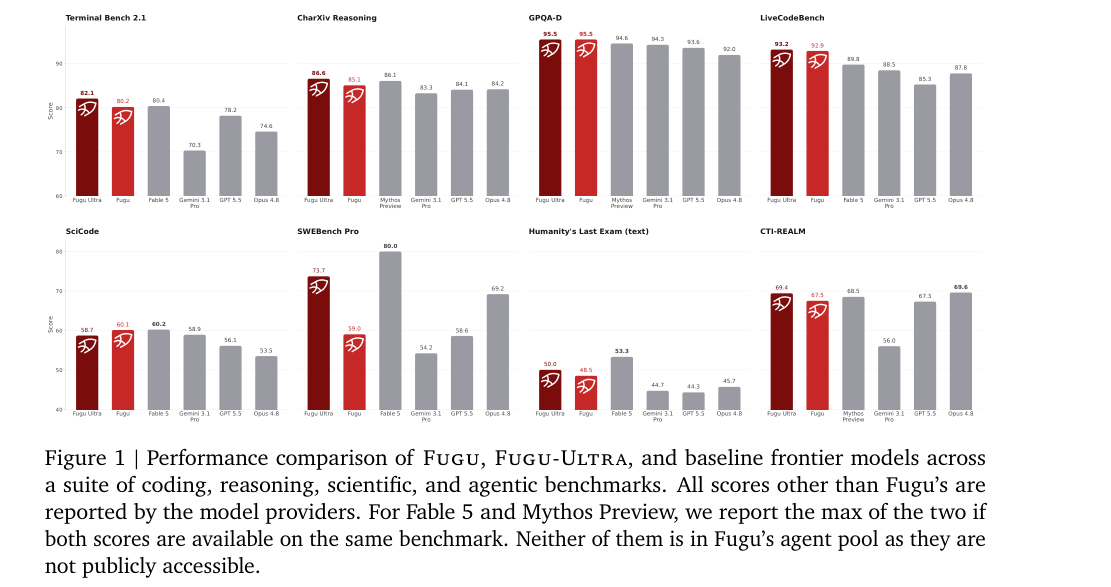
This chart plots the benchmark scores of individual frontier models (Gemini-3.1-Pro, Claude-3.5-Sonnet, GPT-5) alongside Fugu and Fugu-Ultra across eight rigorous engineering, scientific, and coding benchmarks (including SWE-Bench Pro, Terminal-Bench 2.1, and GPQA-Diamond).
Fugu-Ultra achieves higher accuracy on every single benchmark than any individual model in its worker pool, proving that dynamic multi-agent orchestration outperforms even the strongest solo systems.
On rigorous real-world benchmarks, Fugu-Ultra achieved state-of-the-art scores exceeding every individual model in its own pool: 73.7 on SWE-Bench Pro, 82.1 on Terminal-Bench 2.1, and 95.5 on GPQA-Diamond. It proves that collective intelligence can outperform the world’s most expensive single systems.
Key performance metrics, memory benchmarks, and milestone numbers
Tang, Y., et al. (2026). Sakana Fugu Technical Report. arXiv:2606.21228 [cs.LG]. Transcribed on Gigi Papers.Transcribed from the arXiv HTML edition; figures cropped from the PDF (v2, 23 Jun 2026). CC BY 4.0 · Sakana AI.